Is any text app truly untraceable?
Let me save you the suspense: not completely. "Untraceable" is a spectrum, not a switch, and the apps that shout it loudest are usually the ones bending the word.
Real traceability has layers — the message contents, the metadata (who, when, how often), the account behind it, and the network path. A genuinely private app can lock the first one airtight and still leak the others. Encrypting your words does not hide that you spoke. Anyone selling "100% untraceable" is selling the cover of the book, not the chapters inside. (If it were truly untraceable, how would their support team find your account when you get locked out?)
The most private text apps in 2026
Session
FreeNo phone number, no email, routes messages over a decentralised network so there is no central log of who talked to whom. The closest mainstream app to "untraceable." Trade-off: a smaller network and no number means fewer friends already on it.
Signal
FreeThe encryption gold standard. Collects almost no metadata. The catch for this list: it needs a phone number, so it is supremely secure but not number-anonymous. Best when you trust the recipient and fear the middle.
Threema
Paid appRandom 8-character ID instead of a number. Strong metadata protection, data stored on device. Costs a few dollars — which means you are the customer, not the inventory.
CoverMe
FreemiumBurner numbers plus encrypted texts and calls, with a private vault. More of a privacy suite than a pure messenger. Useful if you want a second number and encryption in one app.
Notice what is not on this list: the "secret SMS spoofer" apps. Those hide a number, not you. For that category see our anonymous texting app guide.
What "untraceable" actually requires
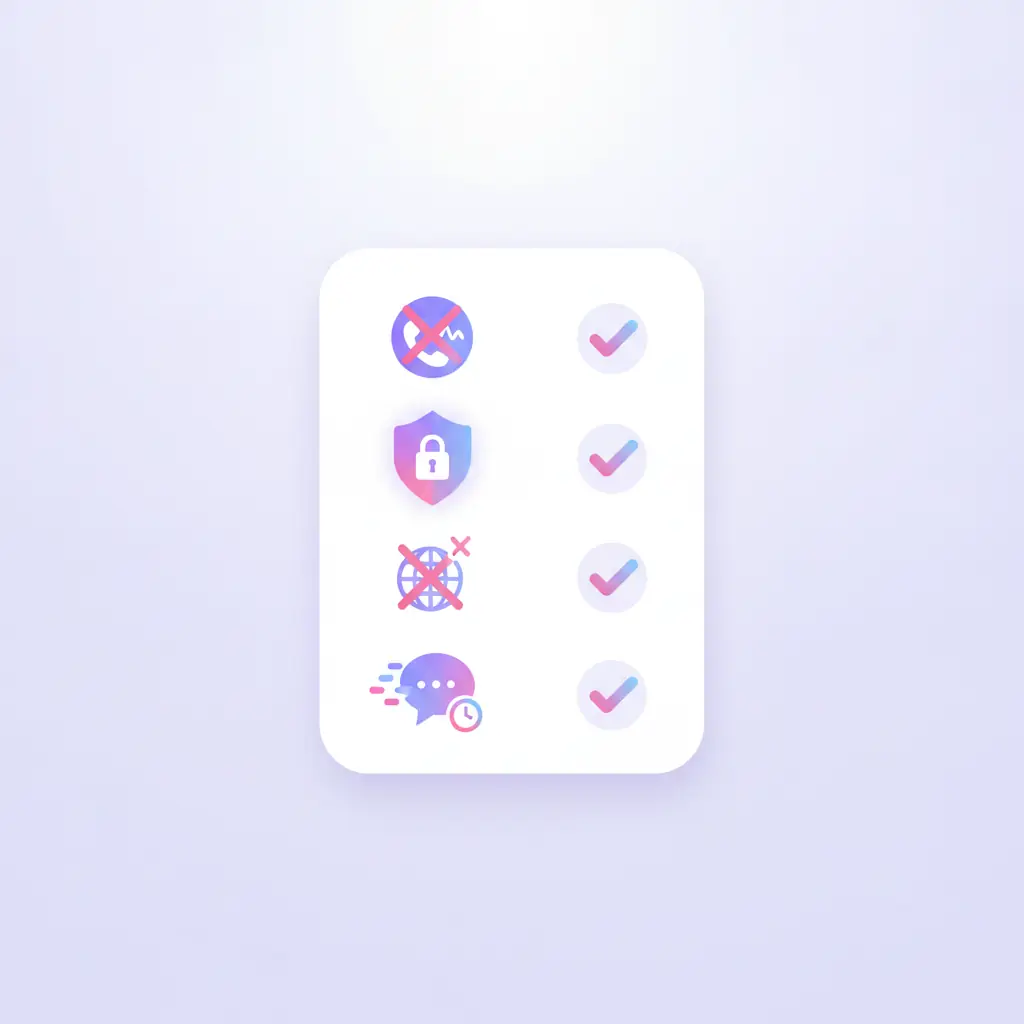
If you genuinely need to approach untraceable, here is the honest checklist. Few apps tick every box, and the ones that do trade away convenience for it.
- No phone number or email at sign-up — the two biggest identity anchors.
- End-to-end encryption by default, not as an opt-in mode.
- Minimal or no metadata logging — ideally no central record of who messaged whom.
- Network-level masking — onion or decentralised routing, or a VPN on top.
- Disappearing messages so there is nothing to recover later.
Tick all five and you are genuinely hard to trace. Tick three and you are "private," which is what almost everyone actually needs. The EFF's Surveillance Self-Defense is the reference I would point anyone to before they trust a marketing badge.
The limits nobody puts in the app store screenshots
Even a perfect app cannot save you from these, so plan around them.
- The other person's phone. Your encryption ends where their screenshot begins. The weakest device in the chat sets the real privacy level.
- Metadata. Even when contents are sealed, patterns — who, when, how often — can say plenty.
- Legal compulsion. A valid order beats any app. Apps that keep little can hand over little, but "little" is not "nothing."
- You. Most de-anonymising is self-inflicted: a detail only you would know, a reused username, a photo with a window in it.
None of this means privacy is pointless. It means privacy is a practice, not a download. The app is the easy 80%. The habits are the other 80%, which is bad math and exactly the point.
Do you actually need untraceable, or just private?
Be honest about the threat. Hiding a surprise party from your group chat is not the same job as protecting a source, and using the wrong tool for either is how people get frustrated or, worse, overconfident.
Most people need "private," not "untraceable" — they want their words unread by strangers and their identity hidden from one specific person. For that, a no-hints anonymous messaging platform or Signal is plenty. If you genuinely need untraceable — activism, whistleblowing, real risk — use Session or Tor-backed tools, assume nothing is perfect, and read a proper security guide before you rely on any of it.
Untraceable app vs VPN vs burner number: what each actually does
Three tools get lumped together as "anonymous." They solve different problems, and stacking them is how you actually get private.
- A private text app (Session, Signal) hides your message contents and, with the right app, your identity from the recipient. It does nothing about your network address.
- A VPN hides your network address — your IP — from the services you use. It does nothing about what you say or which account you say it from.
- A burner number hides your real phone number from the recipient. It does nothing about message contents and still ties to an account.
See the pattern: each covers one layer. Genuine privacy is a private app for the contents, a VPN for the network, and no real-identity account for the trail — together, not one as a magic bullet. Anonymous communication has always worked this way: layers, not switches. Most people need one layer. A few need all three. Nobody needs to pretend a single download is all of them.
Want anonymous, not a second degree in cryptography?
For honest, private messages with no app to vet, a Tell Me Anything link hides the sender by collecting nothing. Free, and refreshingly simple.
Get Your Free Link →